
Next-Generation Low-GWP Refrigerants and Free Cooling in Chiller Design
What does GWP measure?
GWP₁₀₀ compares the warming effect of 1 kg of refrigerant released into the atmosphere with that of 1 kg of CO₂ over 100 years. Using the basis in the table, a 1 kg release of R-454B represents about 465 kg CO₂e in direct emissions. A project estimate accounts for refrigerant charge, annual losses and end-of-life recovery. [1, 6]
HFOs, HFCs and natural refrigerants
HFO stands for hydrofluoroolefin and HFC for hydrofluorocarbon. HCFOs are chlorine-containing hydrochlorofluoroolefins. R-290 is propane, R-717 is ammonia and R-744 is carbon dioxide.
| Refrigerant | Family / composition | GWP₁₀₀ | Safety class |
|---|---|---|---|
| R-1234ze(E) | HFO | 1.37 | A2L |
| R-1233zd(E) | HCFO | 3.88 | A1 |
| R-32 | HFC | 675 | A2L |
| R-454B | HFC/HFO | 465 | A2L |
| R-513A | HFC/HFO | 629 | A1 |
| R-290 | C₃H₈ | 0.02 | A3 |
| R-717 | NH₃ | 0 | B2L |
| R-744 | CO₂ | 1 | A1 |
GWP₁₀₀ values use the basis of the European Commission’s chiller table. Other assessments and regulations may use different values. A/B indicate lower/higher toxicity groups. Class 1 indicates no flame propagation under standard test conditions, 2L is the flammable subclass with low burning velocity, and 3 denotes higher flammability. [1, 2]
HFOs and HCFOs. R-1234ze(E) is an A2L HFO used in water-cooled chillers designed for it. R-1233zd(E) is chemically an HCFO and is an A1 option for low-pressure centrifugal chillers. Compressor geometry and the operating envelope must suit the selected fluid. [3, 4]
HFCs and HFC/HFO blends. R-32 is a single-component HFC and R-454B is an HFC/HFO blend. Both are used in some air-cooled chillers designed for the respective refrigerant. R-513A is an A1 option for some R-134a-class platforms. The CEMS Core ST product page lists R-454B as a series option. Confirm the specific model’s capacity and power input at the intended conditions before ordering. [3, 8, 9]
Natural refrigerants. R-290’s A3 flammability makes charge and installation location early design decisions. Industrial R-717 systems require attention to toxicity, material compatibility and machinery room design. R-744 selection must account for component pressure ratings and transcritical cycle performance in warm weather. [2, 5, 10]
Partial and full free cooling with a dry cooler
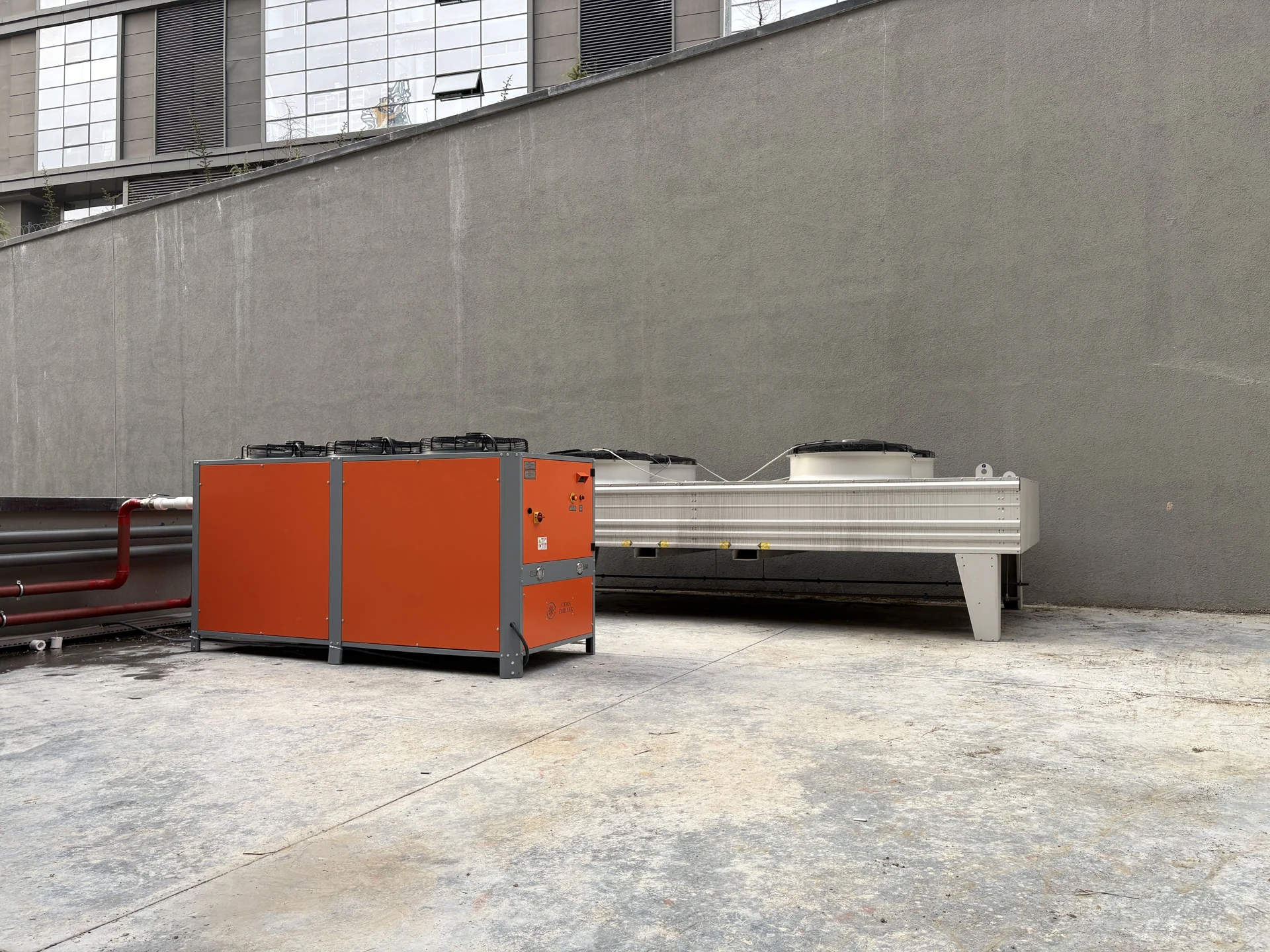
A dry cooler rejects heat from a water or water-glycol loop to outdoor air. When outdoor air is sufficiently cooler than the return fluid, suitable piping and controls let the dry cooler precool the return flow while the chiller meets the remaining load. Once the dry cooler can meet both the leaving fluid setpoint and the full load, the compressor can stop. Fans and pumps still contribute to annual electricity use. [7]
Calculate the changeover temperature for each project. Outdoor dry-bulb temperature, the leaving fluid setpoint, heat exchanger approach and instantaneous load determine available free cooling hours. Include glycol concentration, freeze protection, valve sequencing and additional hydraulic losses. For processes requiring year-round cooling, compare chiller-only and chiller-plus-dry-cooler configurations using the same hourly weather and load data. [7]
What to verify before selection
Define the supply and return temperatures, flow, glycol concentration and annual load profile. Compare full- and part-load input power, fan and pump energy, refrigerant charge and site safety requirements at equivalent conditions. Verify compressor, lubricant, expansion device and pressure-limit compatibility with the manufacturer. An existing unit needs a manufacturer-approved conversion procedure before any refrigerant change. [2, 3, 5, 6]
For the EU market, Annex IV, point 7 of Regulation (EU) 2024/573 governs placing stationary chillers on the market. From 1 January 2027, the GWP thresholds are 150 for rated capacities up to and including 12 kW and 750 above 12 kW. The restrictions cover fluorinated greenhouse gases at or above those thresholds. From 1 January 2032, the restriction for stationary chillers up to and including 12 kW covers all fluorinated greenhouse gases. The relevant provisions include a site safety exception. [11]
Technical references
- European Commission — Climate-friendly alternatives for chillers
- ASHRAE — Refrigerant designations and Standard 34
- ASHRAE Handbook — Liquid-chilling systems
- Trane — Water-cooled centrifugal chillers
- Danfoss — Industrial refrigeration application handbook, ammonia and CO₂
- NREL — Refrigeration Playbook, TEWI
- Trane — Dry coolers and waterside economizing
- CEMS Chiller — Core ST
- Carrier — Air-cooled chillers
- BITZER — R290/R1270 application guide
- EUR-Lex — Regulation (EU) 2024/573, Annex IV, point 7