
Brazed Plate or Shell-and-Tube Heat Exchangers in Chiller Design?
Heat exchanger selection affects a chiller’s energy consumption, footprint, maintenance needs and operating availability. Brazed plate and shell-and-tube heat exchangers serve different requirements. The right choice depends on actual operating conditions, rather than cooling capacity alone.
This article focuses primarily on chiller evaporators. Similar selection considerations apply to water-cooled condensers, but their thermal and hydraulic calculations must be performed separately for the intended duty.
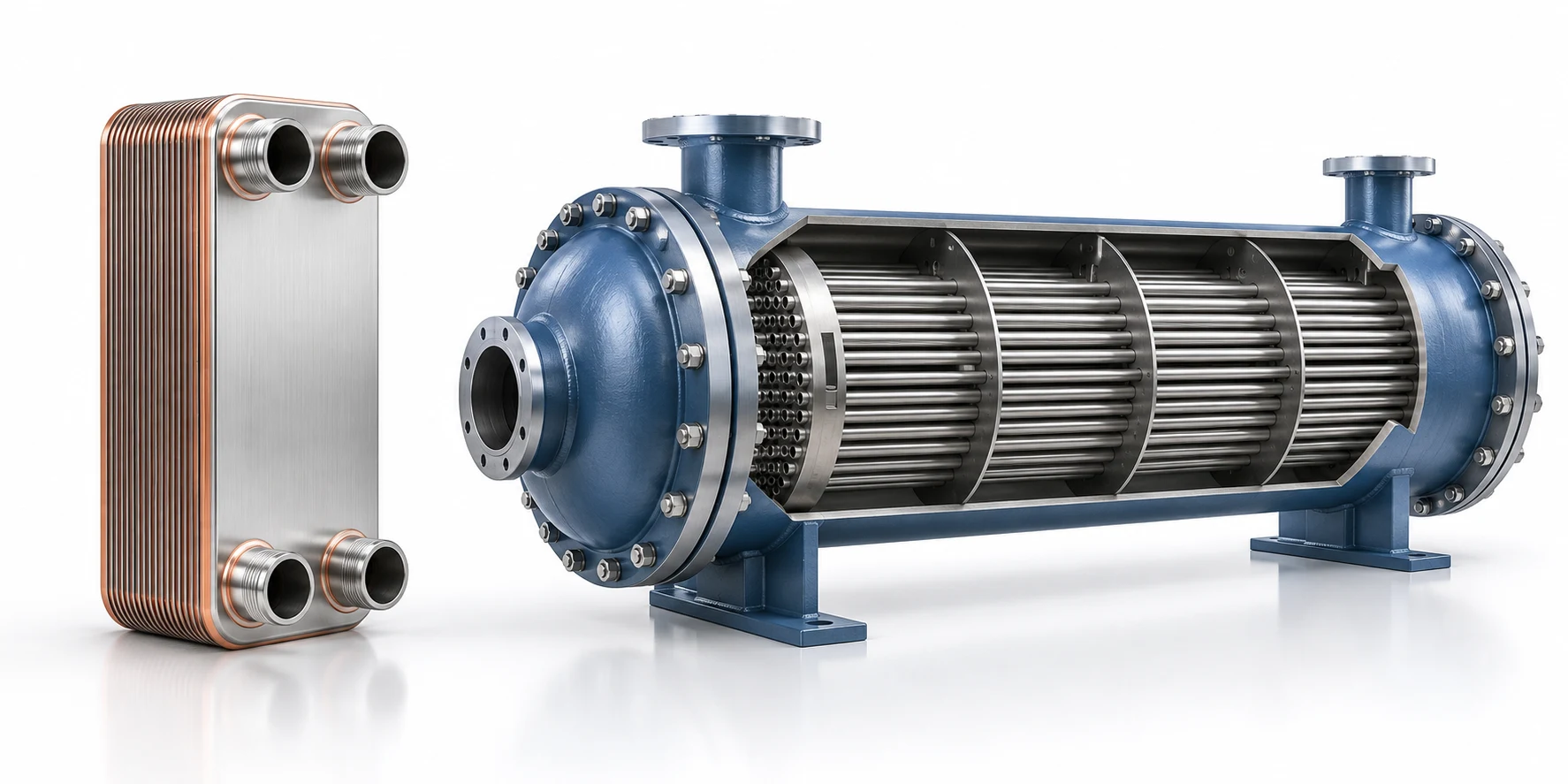
Brazed plate exchanger on the left; shell-and-tube exchanger on the right. AI-generated illustration, not a dimensional drawing or manufacturing reference.
Brazed plate: a compact solution
Brazed plate heat exchangers use formed metal plates joined together to create separate fluid channels. Heat passes through the plates without mixing the fluids. Their compact construction and small internal volume can benefit chillers with limited installation space. The potential to reduce refrigerant charge depends on the selected model and the complete refrigerant circuit. [1, 2]
Narrow channels make system cleanliness and suitable filtration essential. The brazed plate pack cannot be dismantled for mechanical cleaning. Cleaning in place (CIP) may be possible, depending on the deposits and material compatibility. Internal leakage or a blockage that cannot be removed may require replacement of the exchanger. [1, 3]
Shell-and-tube: design and service options
Shell-and-tube exchangers transfer heat through a tube bundle enclosed within a shell. Dry-expansion and flooded evaporators are different arrangements within this category. Fluid allocation depends on the design: a dry-expansion model may carry refrigerant inside the tubes and water on the shell side. [4, 5]
Suitable designs can provide service access through removable covers or a removable tube bundle. However, mechanical cleaning is not automatically available on every shell-and-tube exchanger. Access to the water side, tube geometry and bundle removability must be checked before selection. The layout must also allow sufficient maintenance clearance. [5, 6]
Key selection criteria
| Criterion | Brazed plate | Shell-and-tube |
|---|---|---|
| Installation | Generally compact and lightweight | Assess shell size and service clearance together |
| Water quality | Filtration is critical for narrow channels | Fouling tolerance depends on geometry; water treatment remains necessary |
| Cleaning | Suitable CIP without dismantling | Mechanical access and CIP options depend on the model |
| Material compatibility | Check both plate and brazing materials | Check tubes, shell, covers and seals |
| Performance | Verify at actual temperatures, flow rates and pressure drops | Verify under the same operating conditions |
Evaluate efficiency at system level
A smaller heat exchanger does not necessarily mean lower chiller electricity consumption. Evaporating temperature, water-side and refrigerant-side pressure drops, pump power and part-load operation all matter. Refrigerant distribution and oil return must also be checked at minimum load. A fixed energy-saving percentage cannot be justified from exchanger type alone. [1, 4, 5]
Both solutions require freeze protection. The design should incorporate the manufacturer’s flow limits, flow proving, low-temperature protection and a suitable glycol concentration where needed. Capacity and pressure drop must be recalculated when glycol is used. Standard copper-brazed products must not be assumed compatible with ammonia. [1, 3, 7]
Which option fits the application?
A brazed plate exchanger is a strong candidate for a clean, treated closed water circuit where space is limited. A suitable shell-and-tube design may be preferable when service access, special materials or access to the tube bundle is a priority. For contaminated process fluids, a separate secondary circuit can also be considered to protect the chiller.
Final selection requires cooling duty, inlet and outlet temperatures, glycol type and concentration, water analysis, allowable pressure drop, refrigerant and minimum-to-maximum load data. The best exchanger meets the application’s needs while balancing energy, maintenance and downtime costs throughout its service life.
Technical references
1. Alfa Laval — Heating and cooling FAQ