
Chiller Preventive Maintenance Checklist
Is your chiller still reaching its leaving-water setpoint, but taking longer than it used to? Before replacing parts, record what changed and under which conditions. This guide covers operator checks, routine rounds and scheduled service for industrial air-cooled chillers.
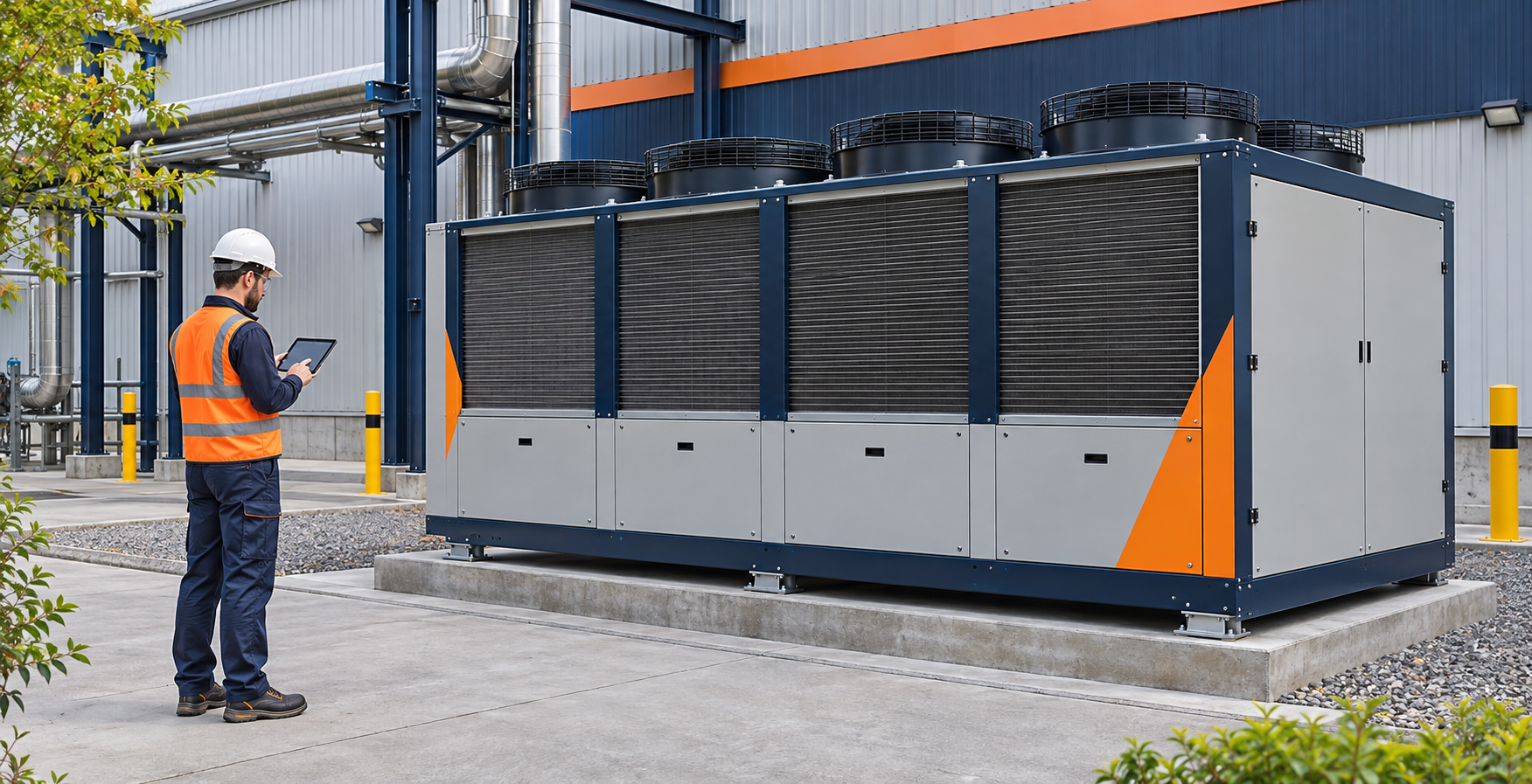
How to set up a maintenance plan
Create a baseline for each unit: model and serial number, commissioning date, water or glycol type, design flow, normal temperature and pressure ranges, pump arrangement and the manufacturer’s schedule. Keep separate records for each chiller.
Dust, plastic fibres, pollen, coastal exposure and long runtimes may call for more frequent checks. Review the schedule against actual fouling and alarm trends. Use running hours and equipment condition alongside calendar dates.
At shift start: What should operators check?
Log the setpoint, entering and leaving water temperatures, outdoor temperature and operating status. Read under stable conditions; note start-ups, stage changes and major changes in production load.
If a pump or flow indicator is available, record its status. Look externally for water leaks, oil traces, unusual noise or vibration and blocked air inlets or outlets. Keep panels and fan guards closed.
Record the alarm code and time. The machines in operation, pump status and water temperatures can be as useful to service staff as the code itself. Do not repeatedly reset recurring alarms.
Routine rounds: Condenser and water circuit
Inspect the coil externally for dust, fibres, leaves, damaged fins and corrosion. Look for walls or roofs that could send warm discharge air back to the intake. A dirty coil is only one possibility; blocked airflow or a failed fan can also affect performance.
Record flow if a meter is fitted. If there are measuring points across the strainer, log the pressure difference. A rising difference at the same flow can suggest fouling. Do not compare readings taken at different variable-speed pump settings without accounting for the change.
Note insulation damage, unexpected condensation and repeated water top-ups. Adding water does not fix leaks and may dilute a glycol mixture. Opening strainers, chemical cleaning and intrusive work belong to service personnel.
Scheduled service and pre-season checks
Depending on the model, service personnel assess coil and strainer cleaning, fans, pumps, flow and heat exchanger performance. The cleaning method must suit the coil; do not assume pressure washing or arbitrary chemicals are acceptable.
Have water quality and, where applicable, glycol type, concentration and freeze protection checked against manufacturer requirements. Before cold weather, include exposed pipes, insulation and fitted freeze-protection equipment. Confirm restart requirements after prolonged shutdowns.
Test flow protection, temperature sensors and alarms using the applicable service procedure. Electrical panel and refrigerant work is for qualified personnel only. Isolate hazardous energy and pressure according to site procedures; never bypass protective devices.
Worked log example: Do not read ΔT in isolation
At 30 °C outdoors and under similar production load, suppose the baseline is 20 °C entering, 15 °C leaving, and 18 m³/h. A later reading of 21 °C entering, 15 °C leaving and 15 m³/h raises ΔT from 5 to 6 °C. Yet the approximate water-side calculation, 1.16 × flow × ΔT, gives about 104 kW in both cases.
Here, higher ΔT alone indicates neither more cooling capacity nor a fault. Check whether the lower flow coincides with a pump speed change, valve position or a higher strainer pressure drop. The calculation assumes steady operation and water; glycol mixtures have different density and specific heat. These values are illustrative, not universal setpoints.
What to record when symptoms appear
| Symptom | Safe observation and record |
|---|---|
| Leaving water above setpoint | Record setpoint, actual temperature, flow, outdoor temperature and production load. Escalate if it persists under comparable conditions. |
| High-pressure alarm | Log the code, outdoor temperature, airflow obstructions and fan status visible from a safe distance. Do not repeatedly reset the alarm. |
| Low-flow or freeze alarm | Log pump status, indicated flow and strainer pressure drop if available. Do not bypass the flow switch; follow site shutdown and service procedures. |
| Water leak, oil trace, burning smell or severe vibration | Keep a safe distance, follow site safety procedures and notify service staff. An oil trace is not proof of a refrigerant leak. |
Printable maintenance checklist
| Check | OK | Action | Reading / notes |
|---|---|---|---|
| Setpoint and entering/leaving water temperatures | □ | □ | |
| Outdoor temperature and process load | □ | □ | |
| Flow, pump and strainer pressure drop if available | □ | □ | |
| Alarm code and time | □ | □ | |
| Condenser surface and airflow path | □ | □ | |
| Water leaks, oil traces, noise or vibration | □ | □ | |
| Pipe insulation and unexpected condensation | □ | □ | |
| Service required and next inspection date | □ | □ |
Mark non-applicable items in the notes. For each action, record the owner and due date. Give service staff the model, serial number, alarm code and recent readings.