
Chillers for Concrete Batching Plant Cooling Systems
Cooling mixing water helps control fresh concrete temperature in hot weather. It is not necessarily sufficient on its own. Aggregate and cement temperatures, water quantity and production timing must be considered together when selecting the chiller and storage system.
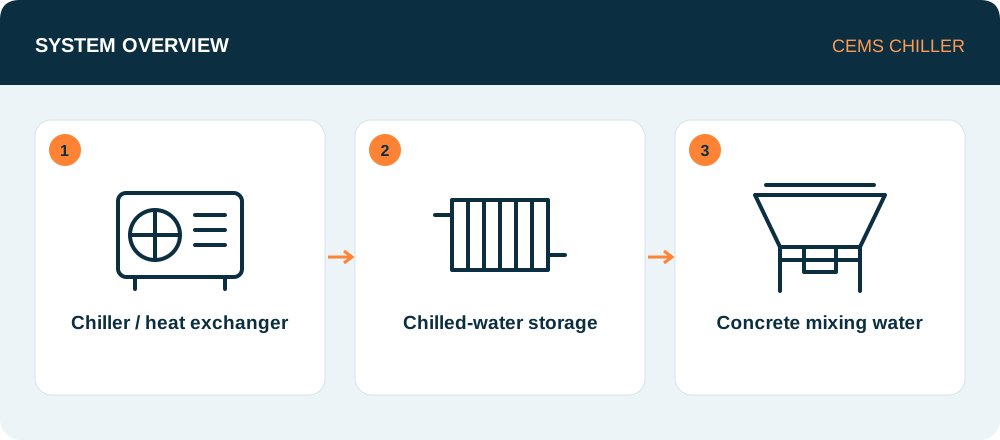
What does the chiller cool?
A common arrangement cools the water that will be metered into the concrete mixer. If a closed utility circuit contains glycol, separate it from the mixing water through a suitable heat exchanger. Uncontrolled utility-fluid contamination of the concrete mix is unacceptable, and water quality must meet project requirements.
Concrete temperature is not simply water temperature
Aggregate, cement and water all contribute to the heat balance through their masses and temperatures. Humidity and wind also affect hot-weather placement. Aggregate shading or pre-cooling may complement water cooling. Define the concrete temperature target through the project specification and concrete-technology assessment. [1] [2]
Worked example: mixing-water duty
For clean water, a useful approximation is Q = 1.163 × flow × ΔT, with flow in m³/h, temperature difference in K and Q in kW. Cooling 10 m³/h from 30 °C to 10 °C requires approximately 1.163 × 10 × 20 = 232.6 kW for the water alone. This example excludes tank and piping gains and does not guarantee a particular concrete discharge temperature.
Match storage to batch production
Average hourly consumption differs from a short, concentrated dosing demand. An insulated tank can help bridge that difference, but cannot eliminate a shortage of daily cooling energy. Calculate storage volume, incoming water temperature, batch intervals and recovery time together. Level control, make-up water and cleaning access also belong in the design.
When water cooling alone may be insufficient
Very hot aggregate or strict mass-concrete temperature limits may require additional measures. Ice is one option, subject to a separate process and mix-design assessment; it must be included in total mixing-water accounting. Select the chiller, pump and condenser for hot, dusty site conditions and preserve airflow and maintenance access. [1]
Information needed for chiller selection
- Hourly concrete output and mix-water requirement
- Incoming and target water temperatures
- Aggregate/cement temperatures and target concrete temperature
- Batch timing, storage volume and operating hours
- Maximum ambient temperature, dust and water quality
Frequently asked questions
Does lowering water temperature lower concrete temperature equally?
No. Every constituent contributes to the heat balance, so the temperature reduction is not one-to-one.
Can storage allow a smaller chiller?
Load shifting may be possible, but verify daily energy demand, the busiest production period and storage recovery time before reducing capacity.