
Chiller Systems for Thermoforming Machines
Controlled cooling after forming is as important as heating the sheet. A correctly selected chiller supports stable temperatures in water-cooled tooling, but the coldest available water does not automatically produce the best part or shortest cycle.
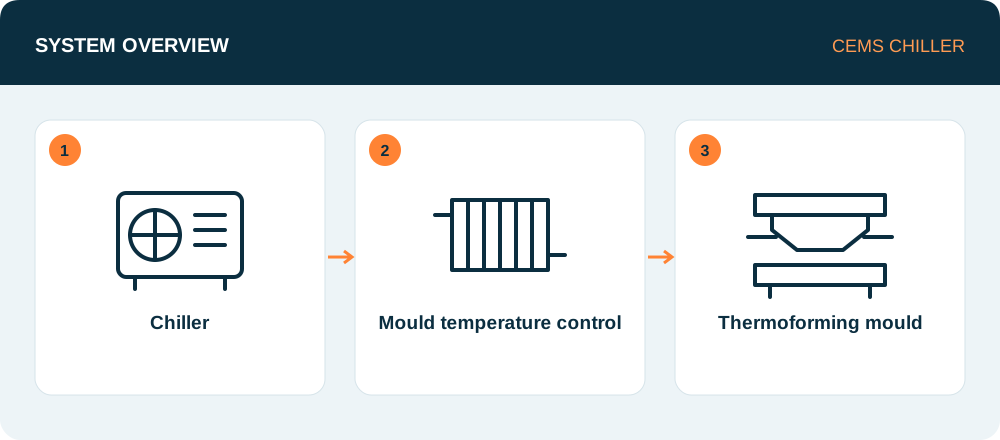
Which parts of the machine need cooling?
Depending on the machine, water may cool the mould or its mounting plates. Some machines also have separate cooling circuits for drives and auxiliary components. Their temperature and flow requirements may differ. Start with the manufacturer’s connection diagram and utility specification rather than assuming all thermoforming machines use the same arrangement. [1] [2]
Why mould temperature matters
Polymer type, sheet thickness, geometry and tooling construction affect cooling behaviour. Uneven mould temperatures can influence dimensional consistency and repeatability. Stable chiller water alone cannot overcome blocked channels or poor distribution. Part temperature at release and cooling-water temperature are different variables; some machines monitor product temperature separately. [1] [3]
Do not size directly from installed heater power
Not all heater input reaches the cooling-water circuit. Energy leaving with the product, ambient losses and different utility circuits must be separated. The machine manufacturer’s cooling-duty and flow data are the best starting point. On an existing installation, measured water flow and supply/return temperature difference help estimate duty, but short cycles require observation over time rather than a single instantaneous reading.
Worked example: checking a water circuit
A clean-water flow of 6 m³/h with a 3 K temperature rise carries approximately Q = 1.163 × 6 × 3 = 20.9 kW. This represents the measured circuit duty, not every future production condition. Faster cycles, different sheets and simultaneous machines require reassessment. For glycol mixtures, use actual density and specific heat instead of the water coefficient.
Condensation, distribution and local control
Surfaces below the ambient dew point may collect condensation. Coordinate process targets, humidity and insulation to avoid unwanted water around the tooling. If a mould temperature-control unit is required, distinguish its role from that of the central chiller. Filtration, flow monitoring, water treatment and hydraulic balancing support repeatable operation.
Information needed for chiller selection
- Machine model and manufacturer’s utility requirements
- Polymer, sheet thickness, product and target cycle
- Temperature, flow and pressure for each circuit
- Simultaneous machines and production schedule
- Ambient temperature/humidity, water quality and maintenance
Frequently asked questions
What percentage cycle reduction does a chiller guarantee?
There is no universal percentage. Establish the existing bottleneck and measure tooling and material conditions before promising cycle or energy savings.
Central or dedicated chillers?
Compare temperature levels, simultaneous demand, pipework, maintenance and production continuity. Neither arrangement is universally best.