
Cooling Milk and Pasteurization Lines: Advantages of Chiller Systems
A chiller supplies cooling to a defined dairy process. It does not perform pasteurization or replace food-safety validation. A properly designed utility system helps maintain product temperature and respond to changing production loads.
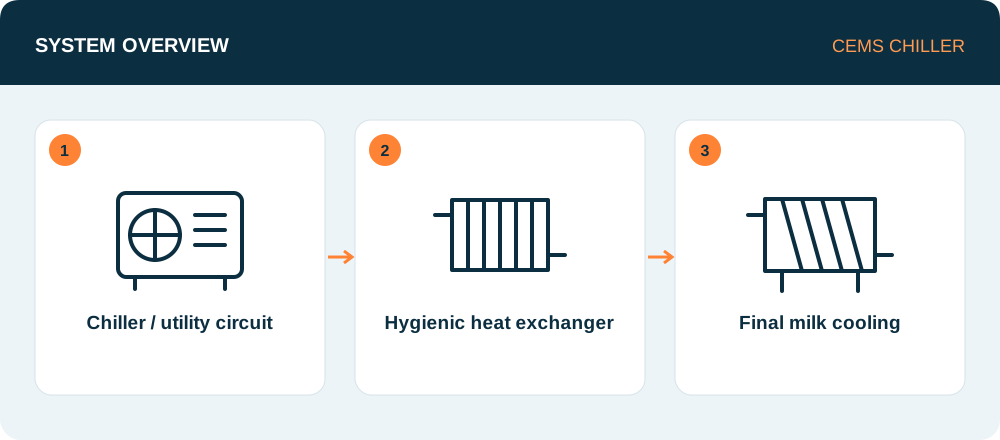
The chiller’s role in a pasteurization line
In many lines, hot product first transfers heat to incoming cold product in a regeneration section. Where required, a final cooling section then uses a cooling utility to reach the target temperature. That target depends on the product and next process step; drinking milk and milk intended for cheese production do not necessarily follow the same temperature programme. [1] [2] [3]
Regeneration changes the cooling duty
Calculating the chiller load from the full difference between pasteurization and final temperature can overlook regeneration. Use the actual temperature entering the final cooling section. Regeneration performance can vary with flow, fouling and start-up conditions, so assess transitions as well as ideal steady-state operation. [2]
Worked example: final cooling duty
Assume 5,000 kg/h of product enters final cooling at 20 °C and leaves at 4 °C. With an assumed specific heat of 3.9 kJ/kg·K, the duty is 5,000 × 3.9 × 16 / 3,600 ≈ 86.7 kW. These temperatures are calculation assumptions, not universal dairy processing or regulatory requirements. Other users, ambient gains and actual exchanger conditions require separate calculation.
Hygienic separation and safety
A suitable hygienic exchanger separates product from the cooling utility. Fluid choice, leakage risk, pressure relationships, material compatibility and cleaning procedures are part of the food-process design. Clean utility water alone is not a hygiene guarantee. Qualified personnel must separately validate pasteurization time/temperature conditions, monitoring and safety functions. [3]
Operational advantages of a chiller system
Controlled utility temperature and sufficient capacity can support more consistent final product temperatures. A central plant may serve several users, but each line’s simultaneous load and control needs must be checked. Heat recovery or free cooling may be considered where suitable; a fixed savings percentage should not be promised. Design circuit separation and operating sequences so that hot CIP conditions do not exceed chiller limits.
Information needed for chiller selection
- Product, line throughput and validated process temperatures
- Actual temperature after regeneration and final target
- Start-up, product changes and simultaneous consumers
- Hygienic exchanger, utility fluid and pressure limits
- CIP arrangement, monitoring, alarms and continuity
Frequently asked questions
Does the chiller pasteurize milk?
No. It is a cooling utility. Heat-treatment validation, hygiene and safety requirements remain separate responsibilities of the pasteurization line.
Is the same chilled-water temperature suitable for every dairy line?
No. Evaluate product targets, exchanger approach temperature, fluid properties and freezing risk together.