
Paint and Chemical Reactor Cooling: Key Chiller Selection Factors
Mechanical mixing in paint production and an exothermic chemical reaction do not impose the same cooling duty. Selection begins by identifying when heat is released, how quickly it must be removed and which product temperature limits must be maintained.
Identify the source of heat
Mechanical energy can become heat in the product during mixing and dispersion. Reactive production adds chemical heat release. End-of-batch cooling, constant-temperature operation and peak duty during dosing are different scenarios. A single capacity estimate based on average daily output can conceal these differences.
Peak load, recipe and response time
Include a temperature-time curve and, where available, a heat-release profile in the selection file. Reaction duty cannot be inferred from vessel volume alone; process-development tests and calorimetry may be needed. Jacket area, agitation and control response also influence achievable heat removal. [2] [3]
Separating chemical and utility circuits
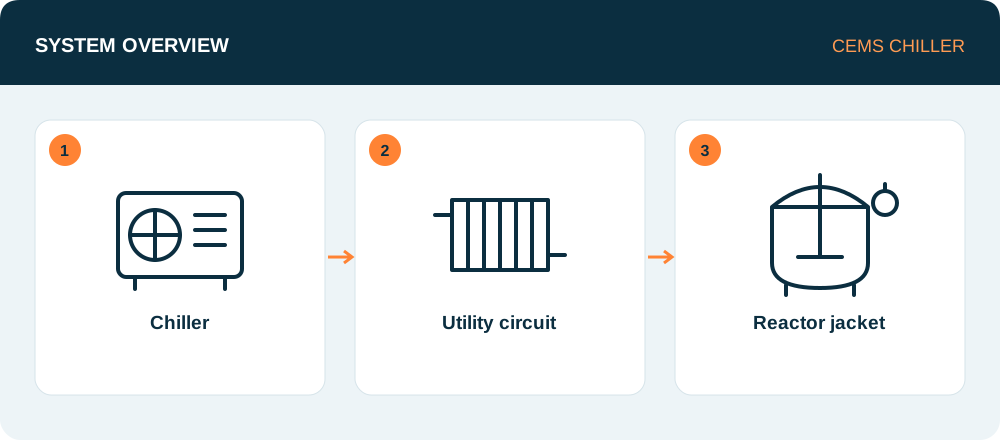
Product, process fluid and chiller water are not interchangeable. Where contamination or incompatibility is possible, consider an appropriately selected intermediate heat exchanger. Its approach temperature and pressure drop affect chiller and pump selection. Choose seals, pipework and exchanger materials for the substances involved.
A chiller does not replace independent process safety
If heat release exceeds heat removal in an exothermic reaction, dangerous temperature and pressure escalation can occur. Qualified process-safety specialists must assess cooling loss, agitation failure and dosing errors. Independent safeguards and emergency measures follow the risk assessment; a standard chiller alarm is not a reactor safety guarantee. [1] [2]
Location and operating checks
Equipment near flammable substances requires a separate assessment of location and suitability. Do not assume that a standard chiller is suitable for a hazardous area. Monitor product temperature alongside jacket supply and return temperatures, flow and filter differential pressure. Revalidate cooling duty after recipe changes.
Information needed for chiller selection
- Product, recipe, safety data sheets and process risk assessment
- Normal and peak heat loads and batch schedule
- Product setpoint, tolerance and allowed rate of temperature change
- Jacket or coil limits, heat-transfer fluid and material compatibility
- Safe shutdown requirements following cooling or power loss
Frequently asked questions
Is the mixer motor rating the required chiller capacity?
No. Consider actual motor loading, operating time, heat transferred to the product, feed temperatures and other loads.
Does a standby chiller alone provide safety?
No. Common power, pump and control failures also matter. Redundancy does not replace independent process-safety design.