
Ice Rink Chillers: Selecting a Low-Temperature Cooling System
An ice rink chiller does more than freeze water. It must maintain the ice during use and recover after resurfacing while working with the building environment. A standard chilled-water capacity rating is therefore not a reliable rink selection on its own.
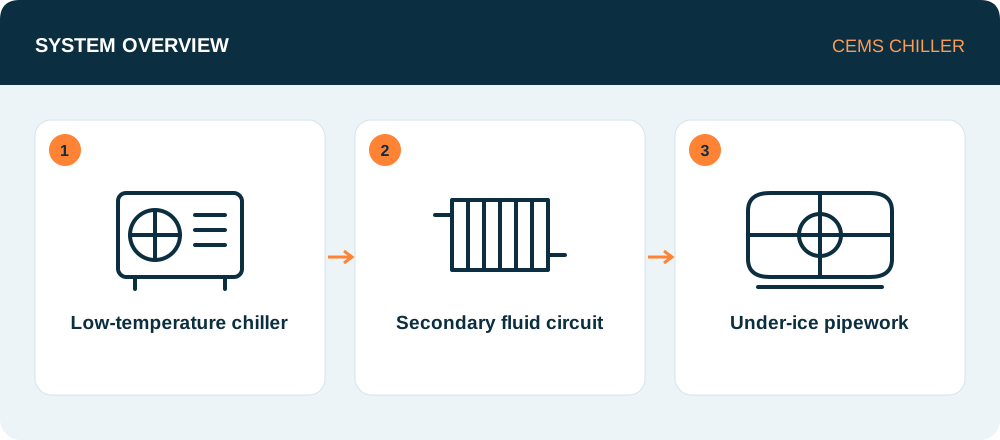
How an indirect rink system works
In a common indirect arrangement, a suitable secondary fluid circulates through pipes beneath the ice. It carries heat from the ice and floor to the chiller evaporator. Freeze protection, pipe distribution, flow and pressure losses must be designed together. Glycol type and concentration depend on the lowest operating condition and equipment limits, not just outdoor temperature. [1]
Initial ice-making and operation are different duties
Initial pull-down cools the floor and water before removing the latent heat of freezing. During use, loads come from the environment, moisture, lighting, users and resurfacing. Calculate both the required ice-making time and peak operating duty, then verify that the selection meets both. A fixed capacity-per-square-metre rule alone is not a final design. [1] [2]
Worked example: freezing duty only
Assume 1,000 kg of water already at 0 °C is frozen completely in one hour. Using approximately 334 kJ/kg for latent heat gives 1,000 × 334 / 3,600 ≈ 92.8 kW. This covers only the phase change. Water pre-cooling, further ice cooling, the floor and environmental gains are excluded. It must not be used as the complete rink capacity.
Verify performance at low temperature
Capacity and electrical demand change with fluid outlet temperature and condenser conditions. Low-temperature operation requires confirmation of the compressor envelope, evaporator, controls and freeze protection. Glycol mixtures have different heat-transfer properties and viscosity from water, so pumps and exchangers need actual mixture data. Do not assume a standard model is suitable for rink service.
Humidity and maintenance also influence ice quality
Ice quality is not determined by the chiller alone. Indoor humidity, air movement, radiation and resurfacing practice also matter. Coordinate dehumidification and the building envelope with the refrigeration design. Monitor flow, supply/return temperatures and the ice surface; include fluid freeze-point checks, filters and air removal in maintenance. [1]
Information needed for chiller selection
- Rink dimensions, indoor/outdoor location and floor build-up
- Required ice-making time and ice quality
- Indoor or outdoor temperature and humidity
- Resurfacing frequency and water volume
- Secondary fluid, pipework and continuity requirements
Frequently asked questions
Can a comfort-cooling chiller serve an ice rink?
Only if the manufacturer confirms the specific low-temperature operating point and all equipment limits. An equal nominal kW rating is not sufficient.
Is thicker ice always better?
No. Additional thickness can increase thermal resistance. Set ice thickness according to the rink operator’s and designer’s requirements.