
Process Chillers and Comfort Cooling Chillers Compared
Cooling an injection mould and cooling a building place different demands on a chiller. Process cooling maintains temperatures required by a product or machine. In comfort applications, a chiller supplies chilled water to equipment such as air handlers and fan coils to support indoor comfort. Selection follows the behaviour of the load and the needs of the facility. [1, 2]
Operating temperatures and load profiles
A 7 °C supply and 12 °C return is one common chilled-water example for comfort cooling. A process may require sub-zero temperatures or substantially warmer water. Its temperature requirement depends on production. Verify the evaporator operating range, fluid and glycol concentration for the application. [1]
Production can continue throughout the year and across multiple shifts. Equipment switching on and off can create abrupt heat-load changes. Building cooling responds to weather, occupancy, solar gains and operating schedules. Buildings with substantial internal loads may also need cooling during winter.
Principal selection differences
| Criterion | Process cooling | Comfort cooling |
|---|---|---|
| Objective | Product quality and machine conditions | Indoor comfort |
| Temperature | Set by production requirements | Set by coil and building design |
| Load variation | Continuous or intermittent production | Weather and building use |
| Control | Required tolerance and response time | Coordination with building controls |
| Hydraulics | Machine flow and pressure requirements | Distribution, coils and control valves |
| Availability | Assess consequences for production | Assess the building’s criticality |
Temperature stability and hydraulics
Derive the temperature tolerance from the process quality requirement. With rapidly changing loads, minimum compressor capacity, loop volume and control response all matter. Insufficient fluid volume can cause short cycling and temperature fluctuations. Check whether a buffer tank is needed using the manufacturer’s minimum-volume calculation. [3, 4]
Pump selection requires both flow and the pressure losses through piping, valves, exchangers and production equipment. Where contamination is possible, consider separating the process circuit with an additional heat exchanger. Include water quality, filtration, material compatibility and glycol effects in the selection.
What does an equal kW rating tell you?
The heat load can be calculated using Q = ṁ × cₚ × ΔT. For example, approximately 17.2 m³/h of water with a 5 K temperature difference carries about 100 kW, assuming a density of 1,000 kg/m³ and specific heat of 4.18 kJ/kgK. Glycol mixtures have different properties. After calculating the load, verify that the selected chiller delivers it at the actual operating conditions.
A catalogue capacity applies at the water and ambient temperatures specified for that model. Compare series and applications only after bringing their ratings to equivalent operating conditions.
Information to include in a quotation request
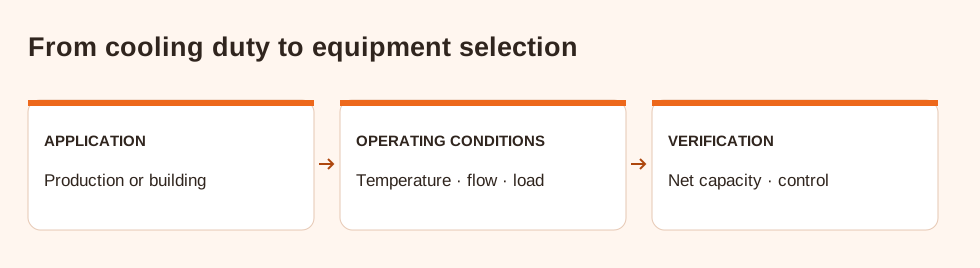
Specify the required net capacity, entering and leaving temperatures, minimum and maximum flow, process pressure requirement and annual operating hours. Add temperature tolerance, minimum load, ambient limits and acceptable downtime. Determine redundancy requirements from the consequences of a failure for the production line or building.